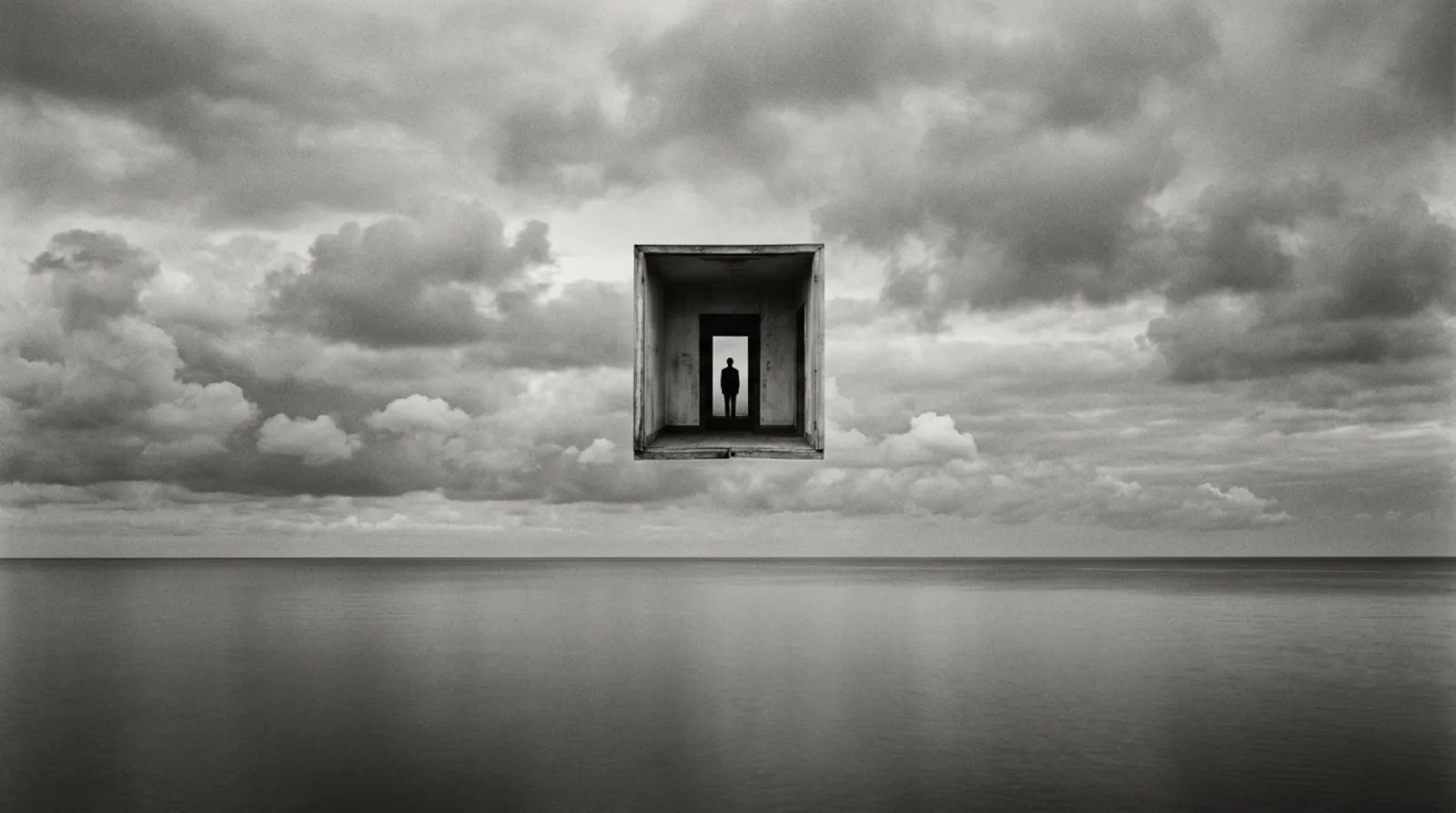
A room floats above a calm sea under heavy clouds. Inside the doorway, the silhouette of a solitary figure.

The Coen Brothers have made many different kinds of films. They have made screwball comedies and folk-music elegies and Western revisionism and suburban farce. But running through virtually all of it is a consistent preoccupation with a particular type of human being: the person who cannot act, or who acts and finds that action changes nothing, or who acts and is destroyed by the consequences without ever understanding why.

This is not the existentialism of Sartre's famous formulation, that existence precedes essence and that human beings are therefore radically free. The Coen Brothers are interested in a bleaker variant: the person who possesses freedom in theory and finds it meaningless in practice. Their characters tend to be not tragically constrained by external forces but tragically unable to exercise the volition that, in theory, is available to them.

The Passive Protagonist as Recurring Form

Before discussing Ed Crane specifically, it helps to map the broader pattern. Jerry Lundegaard in Fargo is a schemer whose plan immediately collapses into chaos he is powerless to contain. He is not a stupid man. He is a frightened one, and his fear paralyzes him precisely when decisive action might save him. Barton Fink, the playwright sent to Hollywood, is consumed by a creative block that renders his artistic ambitions entirely nominal. Larry Gopnik in A Serious Man moves through a series of catastrophes that arrive without cause and depart without resolution, consulting religious authorities who offer him riddles and anecdotes in place of answers.

What these characters share is a relationship to their own lives that is fundamentally spectatorial. They watch things happen to them. When they do act, their actions tend to originate in panic or misapprehension rather than in genuine deliberation. And the universe meets their efforts with indifference, or with something worse: a response that is not punishment, exactly, but consequence without proportion.

Ed Crane: The Purest Case

Ed Crane, the barber at the center of The Man Who Wasn't There, is the Coen Brothers' most concentrated examination of this type. He is introduced through his own voiceover, a narrative device that in conventional noir signals access to the protagonist's inner life. What Ed Crane's voiceover provides instead is a kind of meticulous, affectless description. He describes what he sees and what he does. He rarely describes what he feels, and when he does, the feeling is almost immediately qualified into uncertainty: he is not sure what he wanted, not sure why he did what he did, not sure what anything means.

This is not the laconic stoicism of the classic hardboiled protagonist. Sam Spade and Philip Marlowe, whose terse surfaces conceal principles they are prepared to die for. Ed Crane's silence is not a mask over convictions. It is the thing itself. There may be nothing underneath.

Fate, Causality, and the Noir Universe

The existentialist reading of The Man Who Wasn't There is complicated by the film's explicit engagement with Heisenberg's uncertainty principle, which Ed Crane encounters through a book and seizes on as a framework for understanding his situation. The more precisely you observe something, the less you can know about it. Ed applies this to himself: the more he tries to understand his own situation, the more opaque it becomes.

This is a somewhat eccentric reading of quantum mechanics, but it serves a genuine philosophical purpose. The Coens use it to position Ed's passivity not as a personal failing but as a response to a world in which knowledge and action are structurally disconnected. You cannot act well because you cannot know enough to act well, and the attempt to know more simply generates more uncertainty.

Comparison with the Wider Canon

The film sits in interesting relation to No Country for Old Men (2007), which is the Coens' other sustained engagement with questions of fate and meaninglessness. Where Ed Crane is passive and internal, Sheriff Bell is active and garrulous. He talks throughout the film, about dreams and his father and what the world has become. But his talk is another form of helplessness. He cannot stop Anton Chigurh. He cannot understand a violence that operates outside any moral framework he possesses. He retires. He dreams.

Both films suggest that the specifically American mythology of individual agency is a fantasy that the universe does not share. Ed Crane's version of this is quiet and without bitterness. Bell's version carries genuine mourning. But they arrive at similar territory: the recognition that the self is smaller than it imagines, and the world is less interested in human meaning than the stories we tell about it suggest.

The Comedy Dimension

It would be a mistake to read the Coen Brothers' existentialism as unrelieved darkness. The Dude in The Big Lebowski is also a passive protagonist who is buffeted through a plot he barely follows and cannot control. But the film positions this passivity as a kind of achievement rather than a failure: The Dude abides. He absorbs. He lets the world crash against him and remains, improbably, himself.

This tonal range is part of what makes the Coens unusual. They are not nihilists, not exactly, but they are not consolers either. They maintain the simultaneous availability of tragedy and comedy in most of their work, and the question of which register a given film occupies is often decided less by plot events than by the texture of feeling the filmmakers bring to those events.

Ed Crane's Silence in Context

Ed Crane remains one of American cinema's most fully realized portraits of a man who does not know himself. The film does not offer this as a psychological case study or a social critique. It offers it as a condition, a way of being in the world that the world neither rewards nor punishes particularly, that simply is, until it isn't.

The title announces this: the man who wasn't there. He was there. He was physically present in every scene. But presence, in the sense of selfhood, of a coherent and intentional subject who acts rather than is acted upon, is precisely what he lacks. The film is, among many other things, a meditation on what it means to exist without that kind of presence, and whether the absence is a tragedy, a relief, or simply a description of a condition more common than we care to admit.
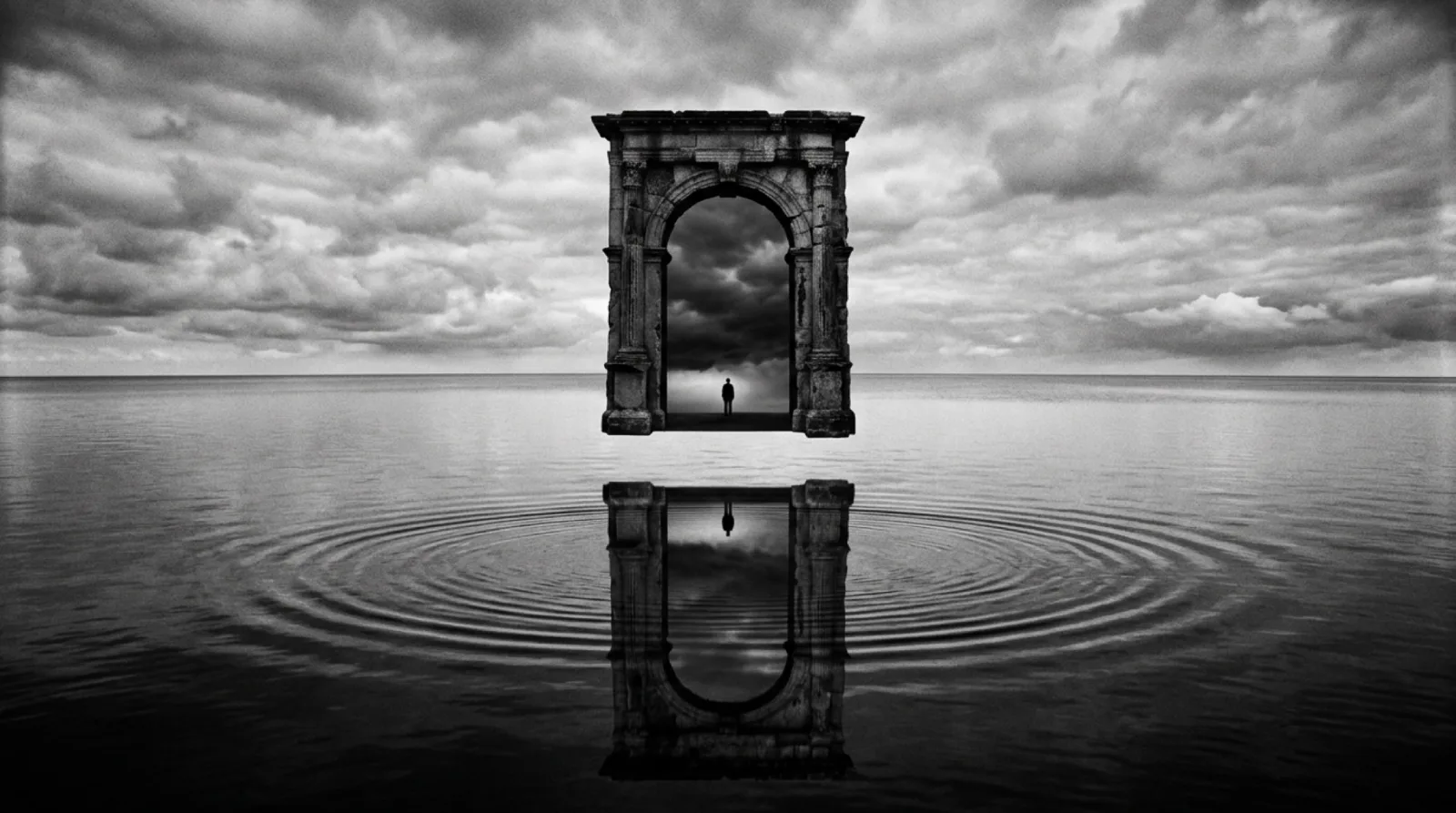
A stone arch floats above a calm sea under dramatic clouds. A solitary figure stands inside the archway. Concentric ripples emanate from the reflection below.

There is a paradox at the heart of The Man Who Wasn't There's visual design. The film looks like a 1940s noir, or rather, it looks like the idealized memory of one, the noir that only exists in retrospect, when every frame has been stripped of the murky compromise and budgetary expedience that characterized the real studio product. That perfection is deliberate, and it is achieved through a technical choice that would have been unavailable to the original noir directors: shooting on color negative stock, then printing entirely in black-and-white.

Roger Deakins has worked with the Coen Brothers on most of their major films since Barton Fink in 1991, and the collaboration on The Man Who Wasn't There represents one of the most concentrated expressions of what that partnership can produce. The decision to shoot color-to-monochrome was made early, and it shaped every other decision that followed: location choice, costume, production design, the specific textures of walls and floors and the fabric of Ed Crane's barber coat.

Why Color Negative for a Black-and-White Film

The obvious question is why not simply use black-and-white stock, as the original noir films did. The answer involves both technology and aesthetics.

Black-and-white negative stock, as it existed in the studio era and as it exists today, was designed to produce black-and-white images directly. The tonal mapping from the physical world to the photographic record is fixed in the emulsion's chemistry. Shooting on color negative and desaturating in printing gives the cinematographer control over how each color in the real world translates to a value of grey. A red wall and a green wall might appear identical in natural grey-scale rendering. By controlling the color filtration during the printing process, a cinematographer can push that red wall toward near-black while lifting the green wall to a pale silver, or vice versa.

For The Man Who Wasn't There, this control allowed Deakins to create the high-contrast look associated with the studio noir cycle without being bound by the technical limitations that produced it.

Light as the Primary Narrative Tool

In interviews about the production, Deakins has described his approach as attempting to find a quality of light that felt simultaneously specific and universal, tied to 1949 California in its period references, but elemental enough that it could describe something about Ed Crane's interior life rather than simply documenting his environment.

The barbershop scenes are a useful case study. Natural light comes through a street-facing window at a low angle, throwing long shadows across the floor and catching the particulate matter, hair and dust, that drifts through the air. Ed Crane stands in a world of accumulation, of small detritus and slow time. The light does not glamorize this. It catalogs it with dispassionate precision.

This is different from the classic noir use of venetian blind shadows, the striped pattern that cinematographers like John F. Seitz deployed in Double Indemnity to suggest confinement and entrapment. That image is explicitly symbolic. Deakins' barbershop light is observational. It records the texture of a specific kind of American commercial space and allows that texture to carry its own implications about the kind of life spent inside it.

Smoke, Glass, and Reflective Surfaces

One of the visual motifs that runs through The Man Who Wasn't There is the use of reflective and semi-transparent surfaces: glass partitions, shop windows, mirrors, the surface of water in a glass. These surfaces do narrative work. They produce doublings, partial images, figures that are present and absent simultaneously. But they also serve a purely optical function within the monochrome palette.

In black-and-white, reflection behaves differently than in color. Without chromatic differentiation, the eye depends entirely on tonal contrast and edge definition to distinguish a reflection from the thing reflected. Deakins exploits this in several key scenes, particularly those involving Ed's wife Doris and her lover Big Dave, where the partial visibility of characters through glass or around corners underscores the film's consistent concern with incomplete knowledge and the unreliability of what is seen.

Cigarette smoke is another persistent element. In color, smoke is a muddy grey-brown, neither beautiful nor meaningful. In high-contrast black-and-white, rendered through a color negative that can be graded to lift or drop the tonal value, it becomes a luminous, softening element. It diffuses hard light, creates intermediate zones between deep black and clear white, and gives Ed Crane a physical atmosphere to inhabit. He is almost always smoking. The smoke surrounds him like a thought he can never quite finish.

Production Design as a Function of Cinematography

Because the film was always intended to be monochrome, the production designer Rick Heinrichs and costume designer Mary Zophres made choices calibrated entirely to how colors would read in grey-scale rather than how they would look in the actual space. This is unusual. Most period films use color as a primary period-authenticity marker, the specific shades of postwar American domestic interiors, the fabric patterns, the paint chips. On The Man Who Wasn't There, those choices had to be translated.

Heinrichs has described using a technique of placing colored gels over lights on set to see how specific colors in the environment would read when the final image was desaturated. A wall that looked warm and domestic in the flesh might, under certain lighting conditions, photograph as an identical grey to the suit jacket of the person standing in front of it, collapsing figure against ground. The production had to engineer spatial legibility in a palette that offered no chromatic cues.

The Legacy of Deakins' Approach

The Man Who Wasn't There arrived at a moment when digital intermediate processing was becoming standard, meaning the precise tonal control Deakins achieved could finally be executed with the granularity the concept demanded. Earlier attempts to shoot color-to-monochrome had been constrained by the blunt instruments of optical printing.

In subsequent years, Deakins' work on the film has been cited repeatedly by cinematographers and critics as a benchmark for how to construct a black-and-white image that transcends pastiche. The achievement is not that it resembles the films of the 1940s. It does, unmistakably. But it uses that resemblance as a starting point for something more demanding: a visual language adequate to the specific kind of absence and silence that Ed Crane represents.

That is what great cinematography does, in the end. It does not decorate a story. It is the story, told at the level of light.


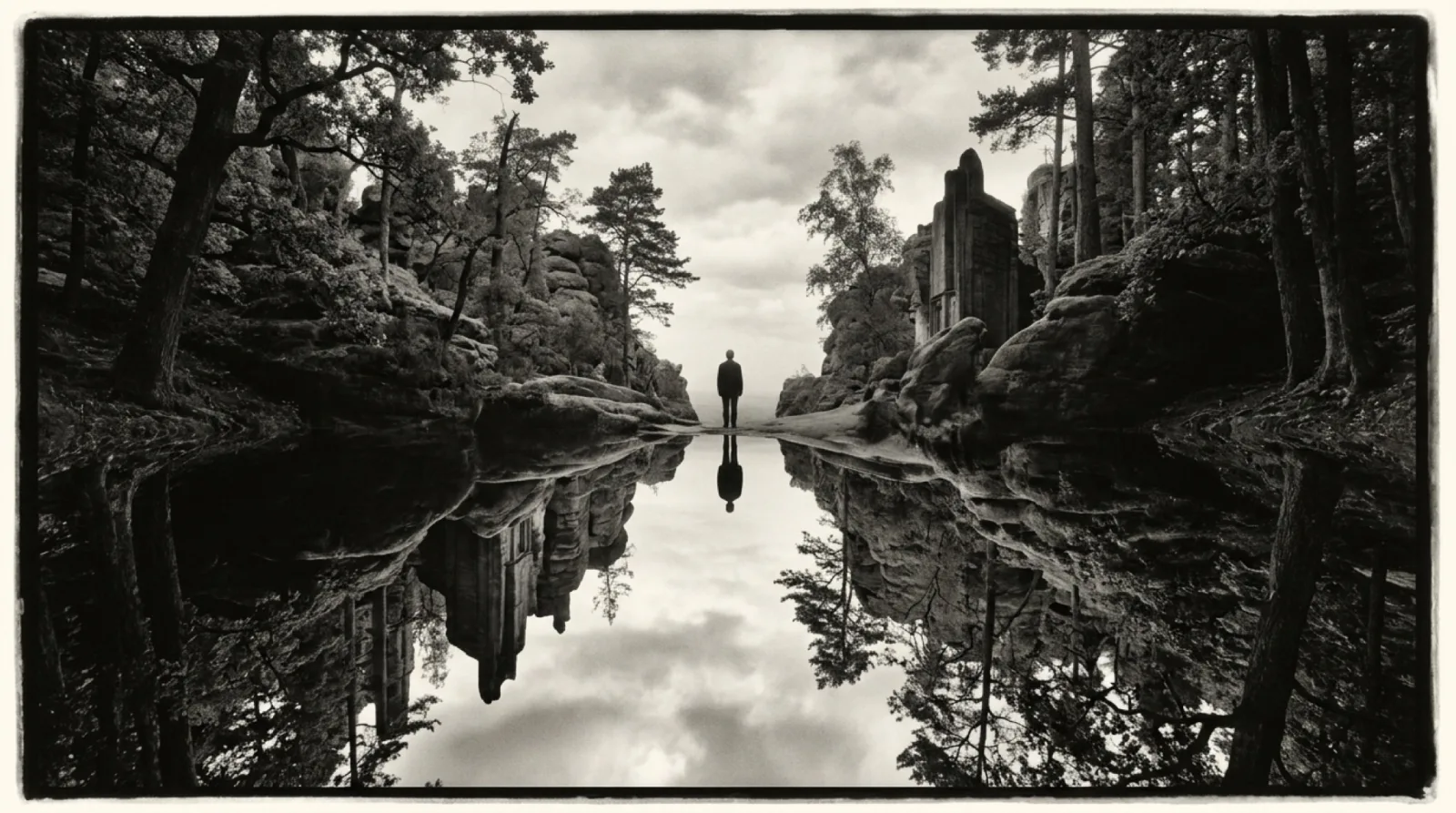
A mirrored landscape of rock formations and trees reflected perfectly in still water. A lone figure stands at the vanishing point where the two worlds meet.

Film noir was never a genre its makers named or intended. The French critics who coined the term in 1946 were looking backward at a body of American crime films, produced between roughly 1941 and 1958, that shared a visual grammar of deep shadow, off-kilter camera angles, and a pervasive sense that the world had gone fundamentally wrong. What those critics identified, Hollywood had stumbled into partly through necessity: wartime material shortages forced economy in lighting, German and Austrian emigre directors carried Expressionist instincts from Europe, and a literary tradition of hardboiled fiction gave writers a language of terse, disillusioned prose that translated directly to screen dialogue.

The classic cycle ended not with a declaration but a slow fade. Television absorbed the crime procedural. Color stock became standard. The Production Code weakened and then collapsed. By the mid-1960s, the shadowy interiors and femme fatales of the studio era looked like period artifacts.

The Revisionist Turn of the 1970s

What followed was not extinction but transformation. Roman Polanski's Chinatown (1974) is usually taken as the founding document of neo-noir: a period film that wears the costumes and vernacular of the 1930s private-eye tradition while systematically destroying every consolation that tradition offered. Jake Gittes is not Sam Spade. He is competent and even decent, and the film punishes him for both qualities. The villain wins. The innocent die. The detective's knowledge changes nothing.

That inversion, using noir's formal vocabulary to reach conclusions the original cycle could not permit, became the template for everything that followed. Robert Altman's The Long Goodbye (1973) had already sent Marlowe shuffling through a 1970s Los Angeles that had no use for his code. Night Moves (1975) gave us a detective whose investigation leads him into paralysis rather than resolution. These films were not nostalgic. They were autopsies of a mythology.

The 1980s and the Problem of Self-Consciousness

By the 1980s, neo-noir had become aware of itself in ways that created new problems. Body Heat (1981) understood that it was transposing Double Indemnity to Florida. Blood Simple (1984), the Coen Brothers' debut, understood that it was watching noirs watching noirs, compressing the genre's characteristic paranoia until the frame nearly burst. Blood Simple works not as homage but as dissection. Every character operates on incomplete information and acts from that incompleteness. The misunderstandings compound without mercy.

The decade also saw neo-noir go transnational. French cinema, which had named the original form, now contributed films like Diva (1981) and Betty Blue (1986) that processed American noir iconography through a sensibility alien to Hollywood. Japanese cinema developed its own noir lineage, as did Hong Kong, where John Woo and Johnnie To would eventually produce the most formally rigorous crime films of the 1980s and 1990s.

The Coen Brothers and the Return to Source

The Man Who Wasn't There (2001) sits at an unusual angle to the neo-noir tradition. Where most neo-noir is set contemporaneously or makes its period concerns explicit, the film chooses 1949 Santa Rosa, California, the same year and rough geography of Hitchcock's Shadow of a Doubt, and refuses to use that setting ironically. Ed Crane is not a clever man reflecting on noir conventions. He is a man who barely thinks at all, who cuts hair because he has always cut hair, who finds himself entangled in a blackmail scheme not from greed or lust but from a vague, inarticulate desire to be something other than what he is.

The film shoots in color and prints in black-and-white, as Roger Deakins and the Coens well understood that monochrome in 2001 would read as deliberate quotation. That is precisely the point. The visual scheme acknowledges that we are watching a constructed past, a memory of cinema as much as a story about people. And yet the emotional investment the film demands is entirely sincere. Ed Crane's opacity is not a postmodern pose. It is a condition the film treats with clinical sympathy.

Neo-Noir After 2000

The twenty-first century neo-noir is a broad church. Christopher Nolan's Memento (2000) borrowed noir's unreliable narrator and made the unreliability structural and neurological. Drive (2011) reduced the form to pure iconography, the stoic driver, the neon-lit streets, the eruption of violence, and let that reduction work as a kind of poetry. True Detective's first season (2014) televised the form's darkest philosophical registers, grafting Thomas Ligotti's pessimism onto a Louisiana procedural.

What connects these works across their obvious differences is a shared understanding that noir is not primarily about crime. It is about knowledge, the gap between what characters know, what they think they know, and what the audience is permitted to see. Crime is simply the mechanism that makes that epistemological problem urgent and irreversible.

The Persistence of Shadows

The critical question facing neo-noir now is whether self-consciousness can still generate feeling. When every filmmaker working in the tradition knows the tradition intimately, when the femme fatale and the corrupt police captain and the night-wet streets have been quoted so many times that they carry quotation marks by default, what remains of the original form's capacity to disturb?

The answer, where it exists, tends to come from filmmakers who use the genre's familiar furniture to furnish genuinely unfamiliar rooms. Unusual settings, unexpected protagonists, moral frameworks that do not map onto the American tradition at all. The form is capacious enough. What it requires, as it always has, is a willingness to follow the implications of darkness wherever they lead, without flinching at the destination.

The Man Who Wasn't There remains one of the clearest demonstrations of that principle. It goes where it goes without apology, and it arrives somewhere genuinely bleak. That is not a failure of the genre. That is the genre at its most honest.